Ingredient Insight — Supplement Ingredients Explained
One supplement ingredient explained every week — what it is, how it works, what the research actually says, and why it's in the formula. No hype, no hedging.
8 min read
What caffeine actually does, why the crash happens, why your 300mg stopped working, and how to read a caffeine label well enough that nobody sells you 350mg of something that is actually 312.
What you're actually paying for. And what you're not.
Three hundred milligrams. That is where most experienced lifters land, and most of them got there by drift rather than decision — a little more each time the last amount stopped feeling like anything.
This tells you whether that number is right, what form it should be in, and how to read a label well enough that nobody sells you 350mg of something that is actually 312.
Everything below is what the published human evidence supports. Where the evidence stops, we say so — it is the only way you can tell a formula from a story.
Key takeaways — Caffeine blocks adenosine rather than stimulating anything. The studied range is 3–6mg per kg of body mass. Dicaffeine malate is roughly 75% caffeine by weight and there is no published pharmacokinetic evidence it is slow release. Theacrine does not appear to habituate over eight weeks, but has not been shown to improve strength, power or endurance.
This distinction sounds pedantic. It is the reason everything else in this article happens.
Adenosine is the by-product of energy you have already spent. As ATP breaks down through the day it accumulates, binds its own receptors, and applies a brake. Neuronal firing slows. Neurotransmitter release drops.
A1 receptors sit throughout the brain and body and do the sedation work — reduced excitability, suppressed neurotransmitter release, central drive damped down.
A2A receptors cluster in the striatum alongside dopamine D2 receptors and interact with them directly. This is the motivation arm. It is why fatigue is not only heavy legs but genuine unwillingness to start the set.
Caffeine is a non-selective antagonist at both. It occupies the receptors and activates nothing. No energy is added. A brake is released, and whatever your nervous system was already trying to do gets on with it.
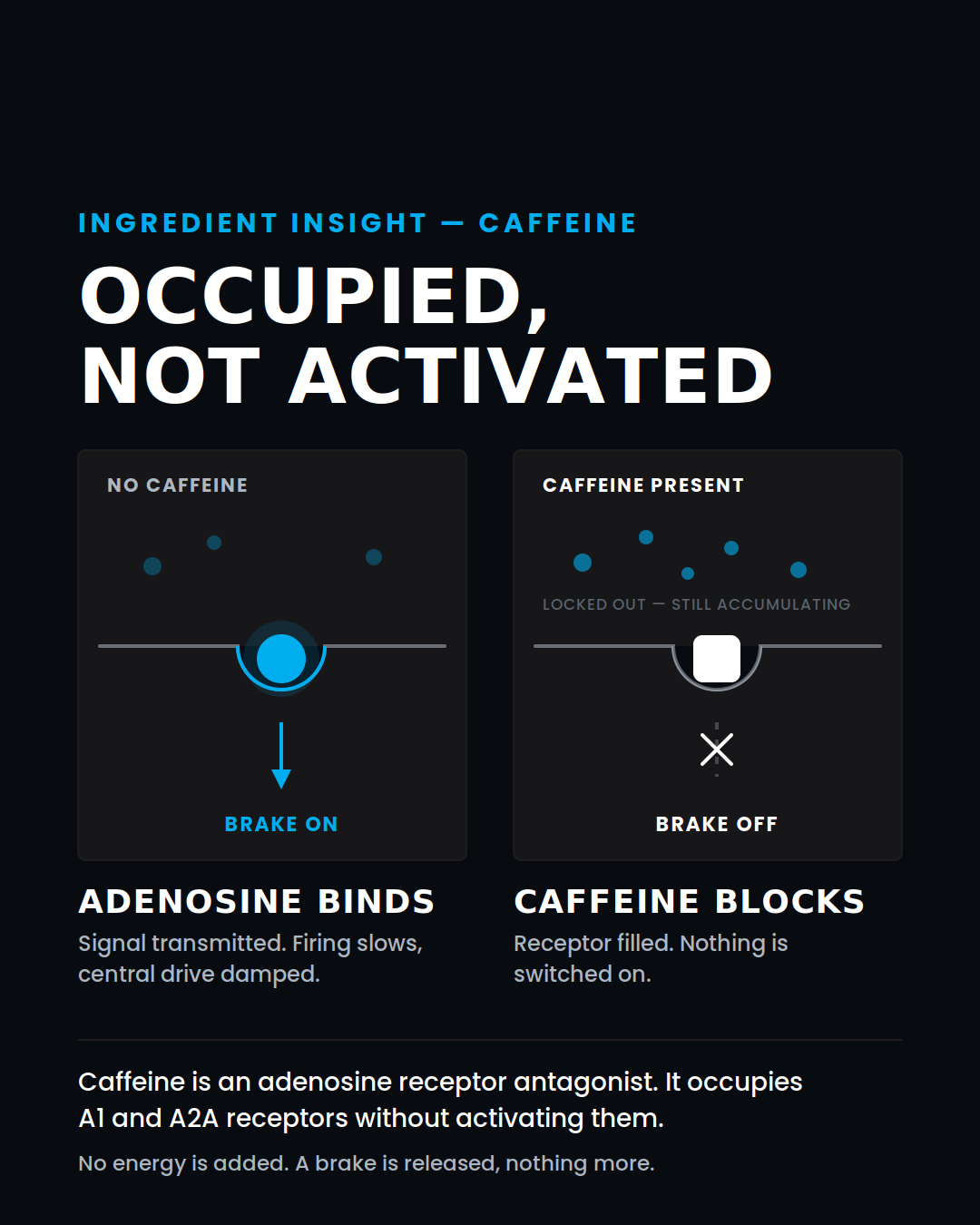
Which means the thing you are buying is not fuel. It is a few hours of unrestricted access to the output you already had. Price it accordingly.
Blocking a receptor does not switch off the process behind it. You are still awake, still spending ATP, and adenosinergic tone — with the sleep pressure that tracks it — keeps climbing the entire time caffeine is on board.
Then the caffeine clears, and what surfaces is not where you were when you dosed. It is roughly where you would have been several hours later had you taken nothing — arriving inside an hour instead of spread across the afternoon.
That is most of the crash. Unmasking, not depletion.
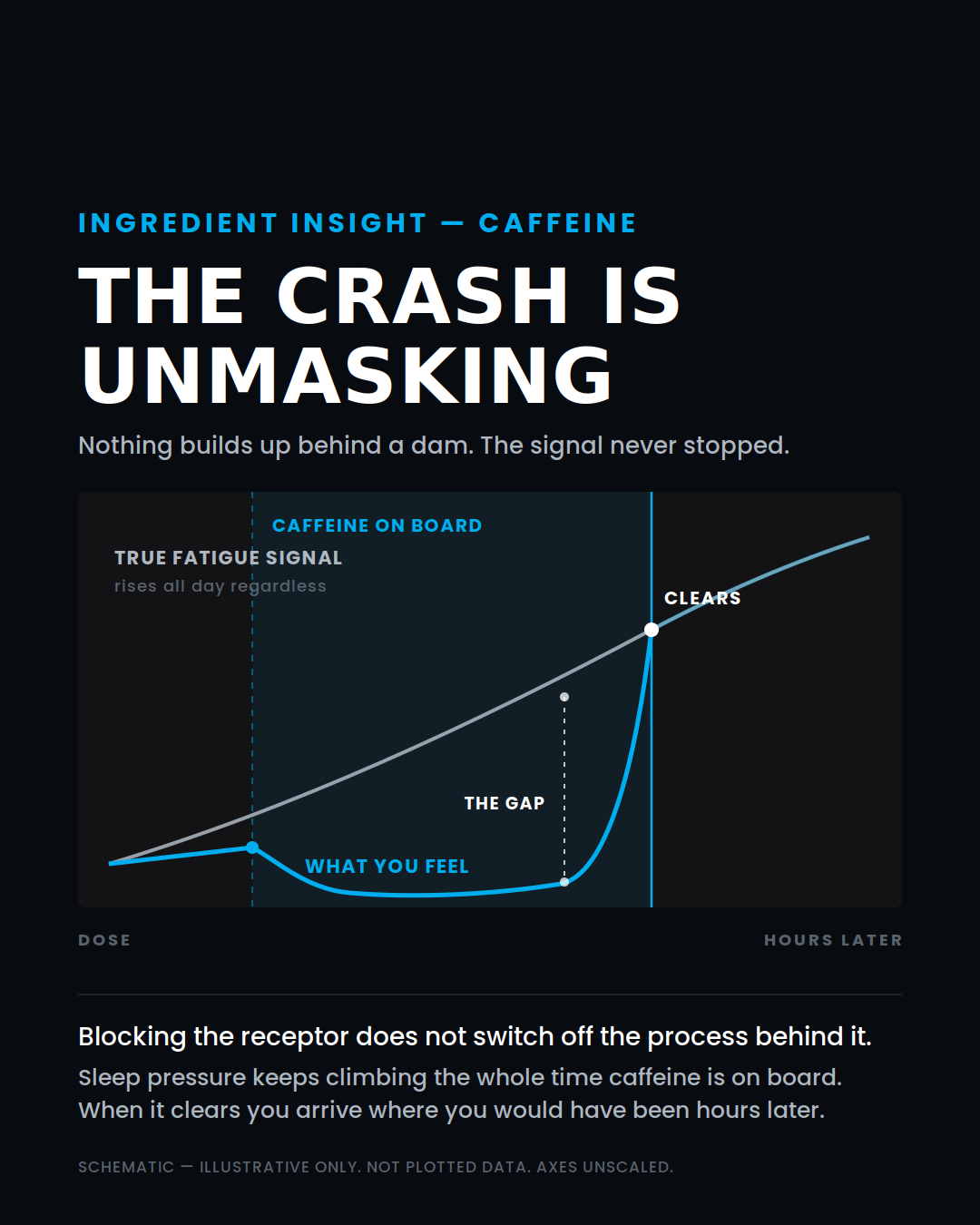
Worth knowing the industry's favourite explanation is wrong. Extracellular adenosine turns over in seconds and clears continuously whether or not its receptors are occupied — there is no reservoir building behind a dam and bursting through. What is supported is simpler: the drive to sleep keeps rising, caffeine masks it rather than removing it, and in daily users part of what feels like a crash is early withdrawal.
Two habits deepen the trough.
The bolus. One large dose gives you a steep climb and, hours later, a steep descent. The higher the peak, the further you have to come down, and the more of that descent lands inside a single stretch of your day.
Escalation. The instinctive fix for a fading effect is more caffeine. That raises the peak and lengthens the blockade, which lengthens the period over which the masked drive keeps building. Longer mask, wider gap between how you feel and where you actually are. This is the most common self-inflicted problem in the category, and it is what a 400mg pre-workout is quietly selling you.
Block a receptor persistently and your nervous system builds more of them. Chronic caffeine intake upregulates adenosine receptor density in the CNS, so the same dose blocks a smaller share of the total and the effect fades. Your sensitivity to your own adenosine rises at the same time, which is why the morning you skip it is genuinely rough.
It moves faster than people expect. Withdrawal has been documented after as little as three days of regular use, with severity building over the following one to two weeks. Stop, and symptoms typically start 12 to 24 hours after the last dose, peak between 20 and 51 hours, and clear over two to nine days.
Here is the part that should change how you plan. Tolerance to caffeine's performance effects is partial, not total. In a 20-day trial at 3mg/kg daily, the ergogenic effect was largest on day one and declined steadily — but a small-to-moderate benefit was still measurable at day 20. Daily caffeine does not stop working on your training. It stops working nearly as well, and the feeling fades considerably faster than the effect.
So if you dose daily you are still getting something. You have just lost the part you can perceive — which is the part you were using to judge whether it was working.
A break resolves the withdrawal: acute symptoms are over inside a week for most people, and tapering rather than stopping dead makes that week far more tolerable. The two-to-three weeks most coaches recommend is a sensible convention built on that timeline, not a figure any trial has established. Anyone quoting you an exact day count for receptor normalisation is extrapolating.
One enzyme does nearly all the work of clearing caffeine: cytochrome P450 1A2.
Typical half-life is four to six hours. The population range is roughly 1.5 to 9.5 hours.
Sit with that. At the fast end, 200mg at midday is essentially gone by early evening. At the slow end, the same dose still has meaningful plasma concentration at bedtime. Same dose, same body weight, completely different night.
The main genetic driver is variation at the CYP1A2 gene, most studied at rs762551. AA carriers clear caffeine substantially faster than C-allele carriers. That effect on clearance rate is well established.
What it means for performance is not. It would be tidy if fast metabolisers simply got more out of it, and one influential trial in trained athletes reported that pattern — but subsequent work has not reliably reproduced it, other controlled trials found no genotype effect on performance at all, and the meta-analytic picture is mixed. Some evidence points to genotype mattering more for timing than for magnitude.
Which is why the genotype tests being marketed at lifters are ahead of the data. You do not need one. Take a fixed dose at a fixed time for a week and watch your sleep — you are already generating the answer.
Caffeine, crystallised and dried. Not a modified molecule.
Oral bioavailability is close to complete and plasma concentrations typically peak within 30 to 60 minutes, which is why the standard research protocol doses around an hour out.
The point most people miss: practically every ergogenic trial ever run used this or a pharmacological equivalent. When a brand cites "the science on caffeine", the science is on anhydrous. It is not the cheap option that premium forms improve on — it is the reference standard they would have to beat, and beating it takes human pharmacokinetic data that mostly does not exist.
Caffeine ionically bonded to malic acid, roughly 75% caffeine and 25% malic acid by weight. So 100mg of dicaffeine malate delivers about 75mg of caffeine. Commit that number to memory — it is the single most useful thing in this article for reading a label.
You will see it sold as slow release, sustained release, extended release, longer lasting, or crash-reducing. None of that is supported by published data. There is no peer-reviewed human pharmacokinetic study comparing dicaffeine malate to anhydrous — no plasma curves showing a flatter peak, a longer tail or a gentler decline. Those claims circulate because they have been repeated, not because anyone measured them.
What can be said: a buffered form that may sit more easily on the stomach. Note the "may" — a reasonable inference from pairing caffeine with an organic acid salt, not a published finding.
And the malic acid is not contributing to your energy metabolism at these quantities. Malate is a Krebs cycle intermediate, which sounds impressive until you remember you eat grams of it in ordinary food and manufacture your own continuously. Tens of milligrams is not an intervention.
Dicaffeine malate is a legitimate ingredient. It is just 75% caffeine with better gut tolerance, and you should pay for it on that basis rather than on a release profile nobody has demonstrated.
1,3,7,9-tetramethyluric acid, a purine alkaloid from Camellia kucha. Structurally close to caffeine, and it interacts with adenosine receptors — which is why it turns up in stimulant formulas.
The strong finding is habituation. In an eight-week trial, 60 healthy adults were randomised to placebo, 200mg or 300mg daily — around 40 on theacrine. Self-reported energy, focus, concentration, anxiety, motivation and mood held broadly steady across the full eight weeks, with no evidence of the habituation you would expect from a neuroactive compound over that period. Safety markers were unremarkable. For a stimulant-adjacent ingredient, that is genuinely unusual.
Now the limits. That trial measured no exercise performance — participants simply maintained their normal training. It is a safety and habituation study and should be cited as one. It also had no caffeine comparator, so it does not show theacrine habituates less than caffeine. Only that it did not visibly habituate.
Performance has been tested separately. In resistance-trained men, 300mg theacrine, 300mg caffeine and a 150/150 combination were compared against placebo across bench and squat 1RM, reps to failure, peak power and velocity, and a 2km row. None improved strength, power or endurance. Only caffeine improved subjective focus, energy and motivation. More recent work found no benefit for cycling time trial performance either.
So: buy theacrine for a subjective effect that appears to hold up over months of daily use. Do not buy it because a label implies it makes you stronger. Two trials went looking and neither found it.
Solid evidence base. Also more modest than the category's marketing implies — and knowing the real numbers is what stops you overpaying for the last 100mg.
Perceived exertion falls. The most consistent finding and probably the most important. At a fixed workload the same effort feels easier. The mechanism is central, following from adenosine antagonism reducing the brain's fatigue signal, and a meaningful share of caffeine's measured performance benefit comes from this alone. The work does not get easier. Your reading of it does — and you do more before you stop.
Muscular endurance improves. An umbrella analysis pooling nine meta-analyses found a standardised mean difference of around 0.30 across roughly 835 participants. Small, reliable, real. Reps to failure go up.
Strength improves slightly. Around 0.18 across roughly 1,600 participants in the same analysis. Statistically robust, but modest. Caffeine is not a 1RM intervention and any label implying otherwise is overselling.
Lower body is the weak spot. In the pooled data, lower-body strength does not reach significance and muscle power sits just the right side of it with a confidence interval touching zero. If you train primarily for jump or sprint output, the case is thinner than the headline.
The studied range is 3–6mg/kg body mass, around 60 minutes out, with benefit reported as low as 2mg/kg in some people. At 9mg/kg you get the side effects without the additional return. There is no evidence of a dose-response curve that keeps climbing.
Now run it on yourself.
| Body mass | 200mg | 300mg | 400mg |
|---|---|---|---|
| 70kg | 2.9mg/kg | 4.3mg/kg | 5.7mg/kg |
| 85kg | 2.4mg/kg | 3.5mg/kg | 4.7mg/kg |
| 100kg | 2.0mg/kg | 3.0mg/kg | 4.0mg/kg |
At 85kg, 300mg is the bottom of the studied range — not the top. At 70kg, 400mg is near the ceiling. The number that matters has never been the one on the tub.
Sixty minutes out is the default for a reason — it matches peak plasma concentration for standard oral caffeine. If the hard part of your session is 50 minutes in, dose to that rather than to the warm-up.
The bigger question is not how early. It is how late.
The most pointed study gave 12 participants 400mg at bedtime, three hours before bed, and six hours before bed, with sleep measured by home monitor. The six-hour condition — a 5pm dose for an 11pm bedtime — cut total sleep time by more than an hour.
That is the finding people should know. This is the one they should find uncomfortable: those participants did not notice. Their subjective ratings did not separate it from placebo. They lost an hour of sleep and reported sleeping fine. Small study, large effect, direction not in dispute.
Put it next to a four-to-six hour half-life and the arithmetic is brutal. 300mg at 5pm leaves roughly 150mg on board at 10pm and around 75mg at 3am — a strong espresso circulating in the middle of the night. At the slow-metaboliser end, considerably more.
Sleep is the largest single input to recovery. Caffeine taken to improve a 6pm session is partly financed by the quality of the 6pm session the next day, and the debt is invisible because you cannot feel it being taken.
Train in the evening? Dose lower rather than later, push as much of your daily total into the morning as you can, and treat anything after mid-afternoon as a deliberate trade rather than a default.
Everything above is only useful if you can apply it in a shop. Six checks, in order.
Run those six on any pre-workout on the market. Most fail at step one.
What's solid. Caffeine blocks adenosine rather than stimulating anything. It lowers perceived exertion, and that is the main route by which it improves training — small-to-moderate gains in muscular endurance, smaller in strength, weakest in the lower body, across a studied range of 3–6mg/kg. Tolerance is real, partial, and arrives within days to weeks. CYP1A2 genotype substantially affects how fast you clear it. Anhydrous is the form the evidence was built on. Dicaffeine malate is roughly 75% caffeine by weight. Theacrine's non-habituation finding is real; its performance case is not.
What's still open. Nobody has properly mapped adenosine receptor recovery in humans after a break, so the right length of one is an estimate. Whether CYP1A2 genotype changes how much caffeine helps you — rather than how long it lasts — remains contested. And there is no published pharmacokinetic comparison of dicaffeine malate against anhydrous, which means a whole category of marketing claims rests on nothing anyone has measured.
We would rather tell you that than sell you the story. Every ingredient we use has to survive the same six checks above — including the ones that would be easier to fudge.
If you already take 300mg before training, three questions will explain more than any change of form: what is that per kilo, what time did you take it, and how long since your last week off.
Is caffeine anhydrous worse than "premium" caffeine forms? No. Practically every trial demonstrating caffeine's ergogenic effect used anhydrous or a pharmacological equivalent. It is the reference standard, not the budget option.
Is dicaffeine malate slow release? There is no published human pharmacokinetic study showing that. The supportable description is a buffered form that may sit more easily on the stomach. It is roughly 75% caffeine by weight, so 100mg delivers around 75mg of caffeine.
How much caffeine should I take before training? The studied range is 3–6mg per kg of body mass, taken around 60 minutes before. Above roughly 9mg/kg the side effects arrive without additional benefit.
Does theacrine make you stronger? Not on the available evidence. Two trials specifically tested strength, power and endurance outcomes and neither found a benefit. Its strong finding is that it does not appear to habituate over eight weeks of daily use.
How long should a caffeine tolerance break be? Acute withdrawal typically resolves within two to nine days. The two-to-three weeks commonly recommended is a practical convention built on that timeline rather than a figure any trial has established.
Why does caffeine stop working? Chronic intake upregulates adenosine receptor density, so the same dose blocks a smaller share of the total. The subjective effect fades considerably faster than the measurable performance effect.
Sources are named in-text by study design, population and finding. Infinergy® is a registered trademark of Creative Compounds. TeaCrine® is a registered trademark of OrthoNutra, LLC.
For information only and not medical advice. Caffeine is not suitable for everyone. If you are pregnant, breastfeeding, taking prescribed medication or have a cardiovascular condition, speak to a qualified healthcare professional before use.
Ingredient Insight publishes every Friday.
This is the baseline. Everything else is built from here.
◆ Founders List
Join the founders list for 20% off the launch range and new guides as we publish them.
Join the Founders ListOne supplement ingredient explained every week — what it is, how it works, what the research actually says, and why it's in the formula. No hype, no hedging.
8 min readSix formulas, six jobs. A private-group first look at what each Baseline formula does and how it does it — clinically dosed, fully transparent, with MAX Catalyst™ across all six. Names and full details at launch.
10 min read